- Who this is for: CTOs, Engineering Directors, Principal Engineers
- Problem it solves: Growing delivery slowdown caused by unmanaged structural code complexity
- Key outcomes: Reduced regression risk, improved cycle time, clearer ownership boundaries
- Time to implement: 60–90 days for structured rollout
- Business impact: Higher engineering throughput without increasing headcount
The Silent Slowdown in Growing Engineering Teams
Your team is shipping.
But velocity is declining.
Cycle time stretches from 5 days to 12.
Regression bugs increase.
New engineers need weeks to understand critical modules.
Refactors are postponed “until after this release.”
Nothing is broken.
Yet everything feels heavier.
This is not a capability problem.
It is structural entropy.
Industry studies consistently show that a significant percentage of engineering capacity in mature systems is consumed by rework, defect correction, and complexity overhead. As codebases grow, unmanaged coupling compounds delivery friction.
Refactoring is often treated as cleanup.
In reality, it is structural engineering for long-term execution stability.
Without method, refactoring becomes emotional.
With structure, it becomes strategic.
Why Ad-Hoc Refactoring Fails
Most organisations approach refactoring in one of three ways:
- Emergency rewrites after production incidents
- Opportunistic clean-up during feature work
- Large-scale “modernization” initiatives
All three are reactive.
They lack classification.
They lack governance.
They lack structural metrics.
The result:
- Teams argue about how much to refactor
- Delivery slows unpredictably
- Architecture reviews become subjective
- Technical debt becomes political
Refactoring must move from instinct to discipline.
The Structured Refactoring Model
Not all refactoring is the same.
Different structural problems require different levels of intervention.
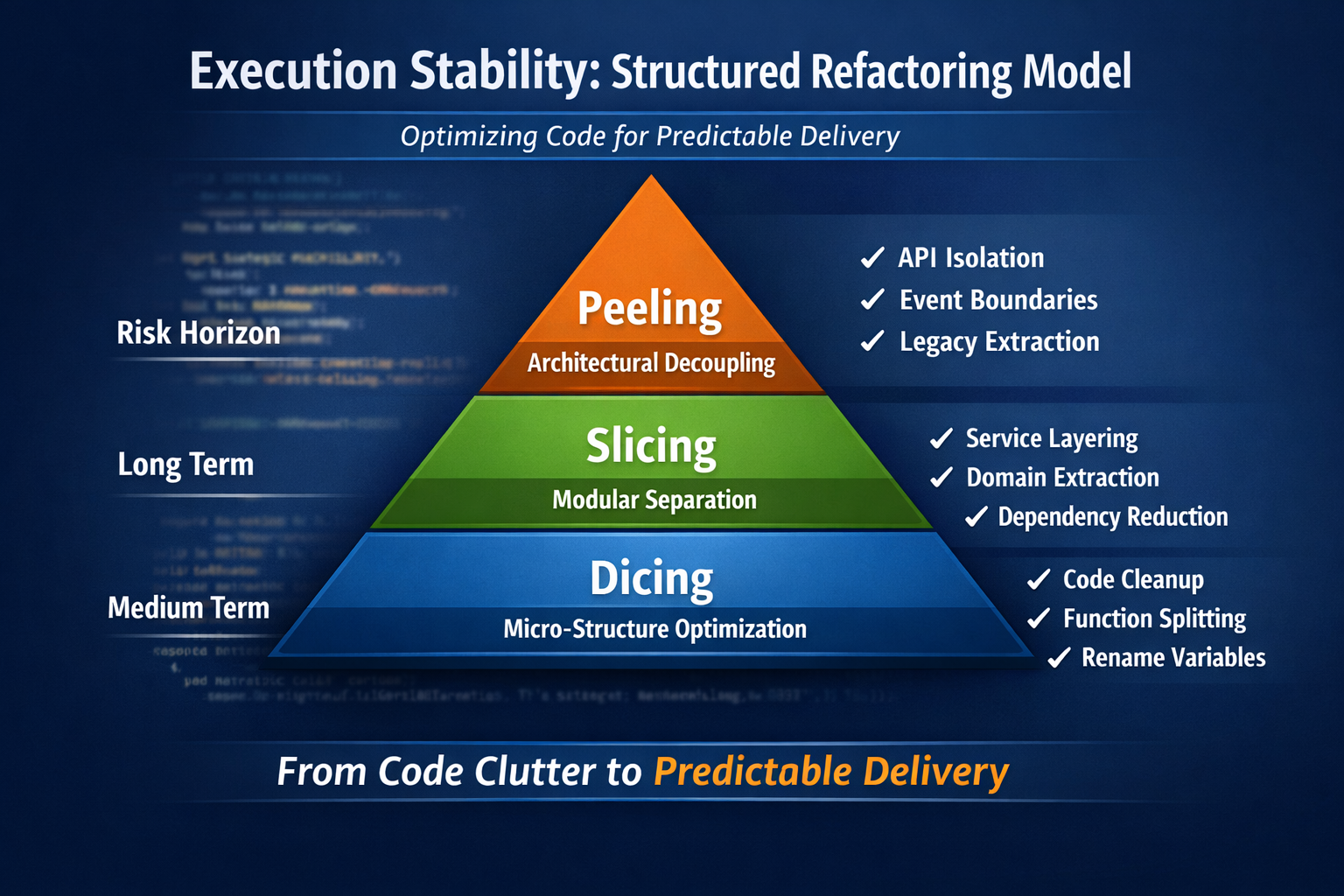
I use a three-layer model:
- Dicing – Micro-structure correction
- Slicing – Logical boundary extraction
- Peeling – Architectural decoupling
Each serves a different risk horizon.
1. Dicing – Micro-Structure Optimization
Dicing addresses internal code clarity without changing system topology.
Examples:
- Renaming ambiguous variables
- Breaking long functions
- Reducing cyclomatic complexity
- Eliminating duplication
- Improving unit test coverage
This is low-risk structural tightening.
When to Use Dicing
- High cognitive load modules
- Repeated bug patterns
- Difficult onboarding areas
- Localized code smells
Business Impact
- Faster debugging
- Lower regression probability
- Reduced onboarding time
Dicing improves internal clarity without altering architecture.
It is structural hygiene.
2. Slicing – Logical Boundary Extraction
Slicing isolates coherent responsibilities and reduces coordination friction.
Examples:
- Extracting service layers
- Separating domain logic from infrastructure
- Breaking large modules into bounded components
- Reducing dependency density
This affects how teams collaborate.
It improves ownership clarity.
When to Use Slicing
- Frequent merge conflicts
- Blurred domain ownership
- High change collision between teams
- Escalating integration complexity
Business Impact
- Parallel development improves
- Coordination overhead reduces
- Deployment predictability increases
Slicing aligns code boundaries with organisational boundaries.
3. Peeling – Architectural Decoupling
Peeling restructures deeper system layers to reduce structural coupling.
Examples:
- Extracting legacy core behind stable APIs
- Introducing asynchronous boundaries
- Removing shared database dependencies
- Isolating high-risk legacy subsystems
Peeling changes topology.
It must be governed carefully.
When to Use Peeling
- Scaling limitations
- Regulatory isolation requirements
- Platform modernization initiatives
- Acquisition integrations
Business Impact
- Reduced blast radius
- Independent scaling paths
- Long-term strategic flexibility
Peeling is incremental re-architecture — not a rewrite.
Implementation Guide (90-Day Rollout)
Phase 1: Structural Mapping (Weeks 1–3)
Objective: Diagnose structural risk
Activities:
- Identify high-complexity modules
- Map dependency density
- Measure regression hotspots
- Audit test coverage gaps
Success Metric:
- Refactoring opportunities classified into Dicing, Slicing, or Peeling
Phase 2: Governance Integration (Weeks 4–6)
Objective: Make refactoring measurable and disciplined
Activities:
- Introduce refactoring classification in PR templates
- Allocate 15–20% sprint capacity to structural improvement
- Define structural risk indicators
- Link refactoring type to delivery risk
Success Metric:
- No refactor without classification
- Reduced debate around priority
Phase 3: Controlled Execution (Weeks 7–12)
Objective: Improve structural fitness without destabilization
Activities:
- Prioritize high-risk slicing candidates
- Schedule incremental peeling with rollback strategy
- Track regression rate per refactor type
- Monitor coupling trend reduction
Success Metrics:
- Reduced regression incidents
- Improved deployment frequency
- Lower cycle time variance
Resource Estimate:
1 Principal Engineer
1 Engineering Manager
Architecture oversight
Evidence from Practice
The Challenge
In a previous engagement, a growing product team experienced declining velocity despite increasing headcount.
Merge conflicts rose significantly.
Regression bugs increased.
Feature estimates were consistently underestimated.
The architecture was not fundamentally flawed.
The structure was congested.
The Approach
We introduced structured classification of refactoring work:
- Micro-clarity issues were diced immediately.
- Ownership conflicts triggered slicing.
- High-coupling legacy modules were incrementally peeled.
Rewrite discussions were avoided.
Structural risk was measured instead of debated.
The Results
Within four months:
- Regression incidents reduced by approximately 25%
- Merge conflict frequency declined
- Onboarding time improved
- Feature predictability stabilized
No rewrite.
No platform migration.
Structural clarity improved.
Action Plan
This Week
- Identify your top 5 high-friction modules
- Classify each as Dicing, Slicing, or Peeling
Next 30 Days
- Introduce refactoring type in pull request templates
- Track regression rate post-refactor
- Allocate structural improvement capacity in sprint planning
3–6 Months
- Integrate structural risk metrics into architecture review
- Audit dependency density quarterly
- Make refactoring part of governance rhythm
Final Thought
Code does not decay suddenly.
It accumulates structural stress.
Without method, refactoring becomes reactive.
With classification, it becomes strategic engineering.
Dicing improves clarity.
Slicing improves alignment.
Peeling improves resilience.
Execution stability is built in layers.
Next Step
If your engineering team is slowing despite growth, debating rewrite strategies, or facing increasing regression risk —
→ Book a 30-minute strategy consultation
Structured refactoring restores delivery predictability without disruption.